The budget line says RM60,000. Nobody can say exactly what that buys until the quotes come back, and when they do the same brief arrives at RM38,000 from one supplier and RM95,000 from another.
Neither number is wrong. They’re pricing different things.
POSM cost in Malaysia turns on a handful of variables that most briefs never specify. Once you know what they are, quotes stop looking arbitrary.
Where the money actually goes
- Material — the biggest lever, and it’s decided by how long the display has to survive
- Structure — whether anyone engineered it, or copied a shape that worked before
- Print process — digital, offset or silkscreen; volume decides which is cheaper
- Quantity — unit cost falls in steps, not smoothly
- Finishing — lamination, spot UV, die-cutting, heat bending. Each one is another pass through a machine.
- Installation — a separate cost, and the one most often left out
- Freight and spares — especially anything crossing to Sabah or Sarawak
Material and lifespan are the same decision
The most common budgeting mistake is picking a material and then asking how long it will last. It works the other way round. Decide how many weeks the display has to stand, and the material picks itself.
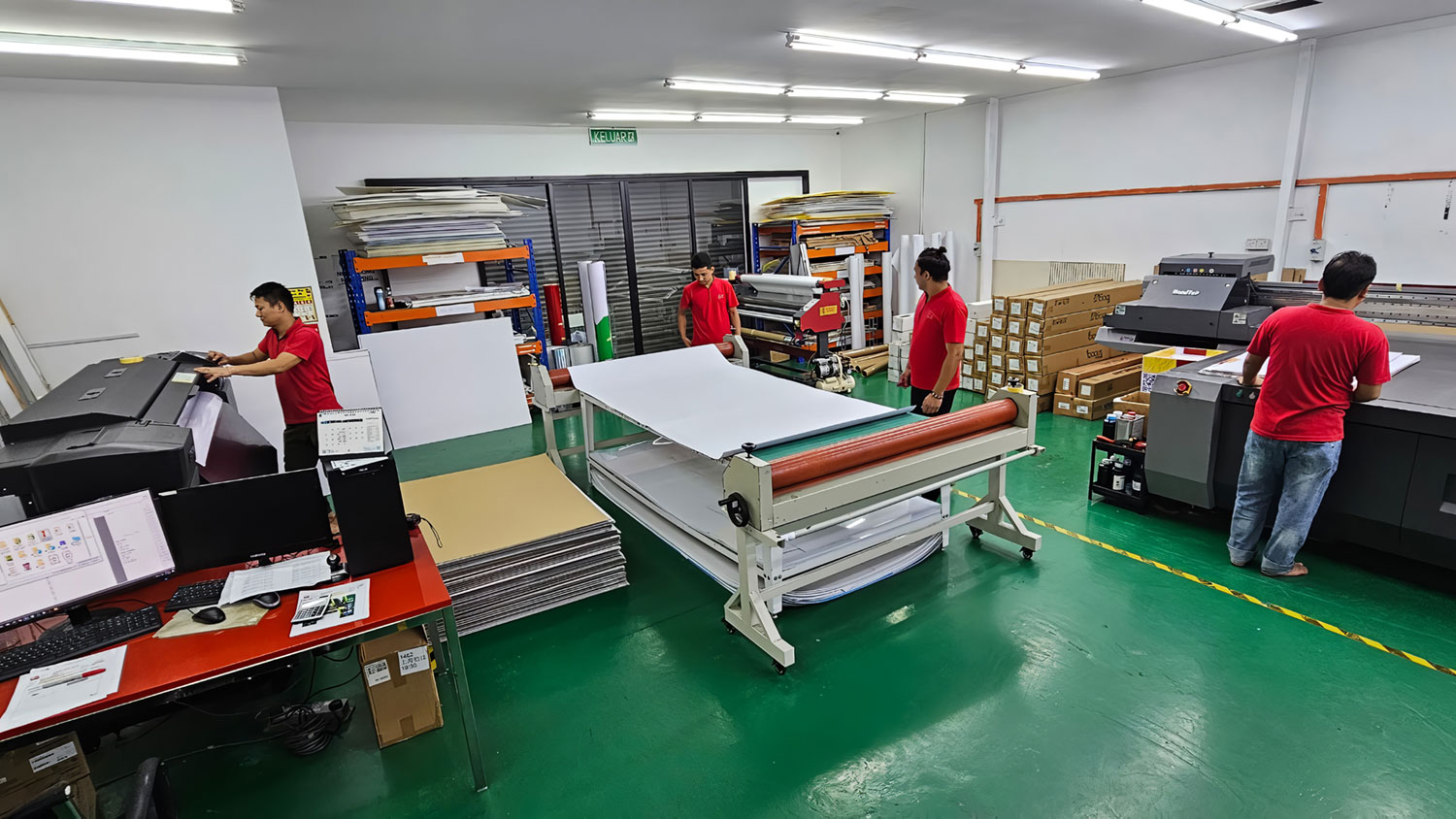
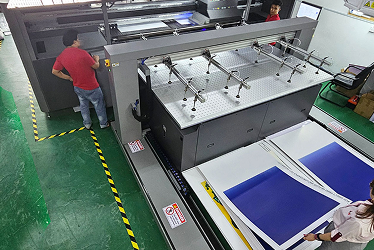
Board stock waiting on a job. Material is really a lifespan decision, and it sets most of the unit cost before a single sheet is printed.
|
Display type |
Typical lifespan |
|
Corrugated standee, ~1.5m |
2–6 weeks |
|
Corrugated block display / floor stack |
2–8 weeks |
|
Foamboard or chipboard counter unit |
4–12 weeks |
|
Acrylic or ABS semi-permanent unit |
12–52 weeks |
|
Metal and HPL permanent unit |
1–3 years |
|
Wobbler or shelf talker |
Campaign length |
Stop comparing unit cost. Compare cost per week.
A corrugated standee at RM __ that stands for three weeks costs about RM __ a week in store. An acrylic unit at RM __ that runs a full year costs about RM __ a week.
The cheaper unit is often the more expensive display. It is the single most useful calculation in a POSM budget and almost nobody does it.
It also changes what you should be asking for. If a promotion repeats three times a year, a semi-permanent unit with a re-dressable header usually beats three separate temporary builds. You reprint a panel instead of rebuilding a structure.
Quantity: where the price cliffs are
Unit cost doesn’t slide down gently. It drops at specific points, because the process underneath changes.
- Below about __units, setup and tooling dominate. You are paying for the die more than the board.
- Around __units, [digital gives way to offset / silkscreen], and per-unit print cost falls sharply.
- Beyond about __units, material and labour dominate and the curve flattens. Ordering more stops saving much.
Knowing where your quantity sits against those points is worth more than negotiating. Moving from __ to __ units can cost less in total than the smaller order.
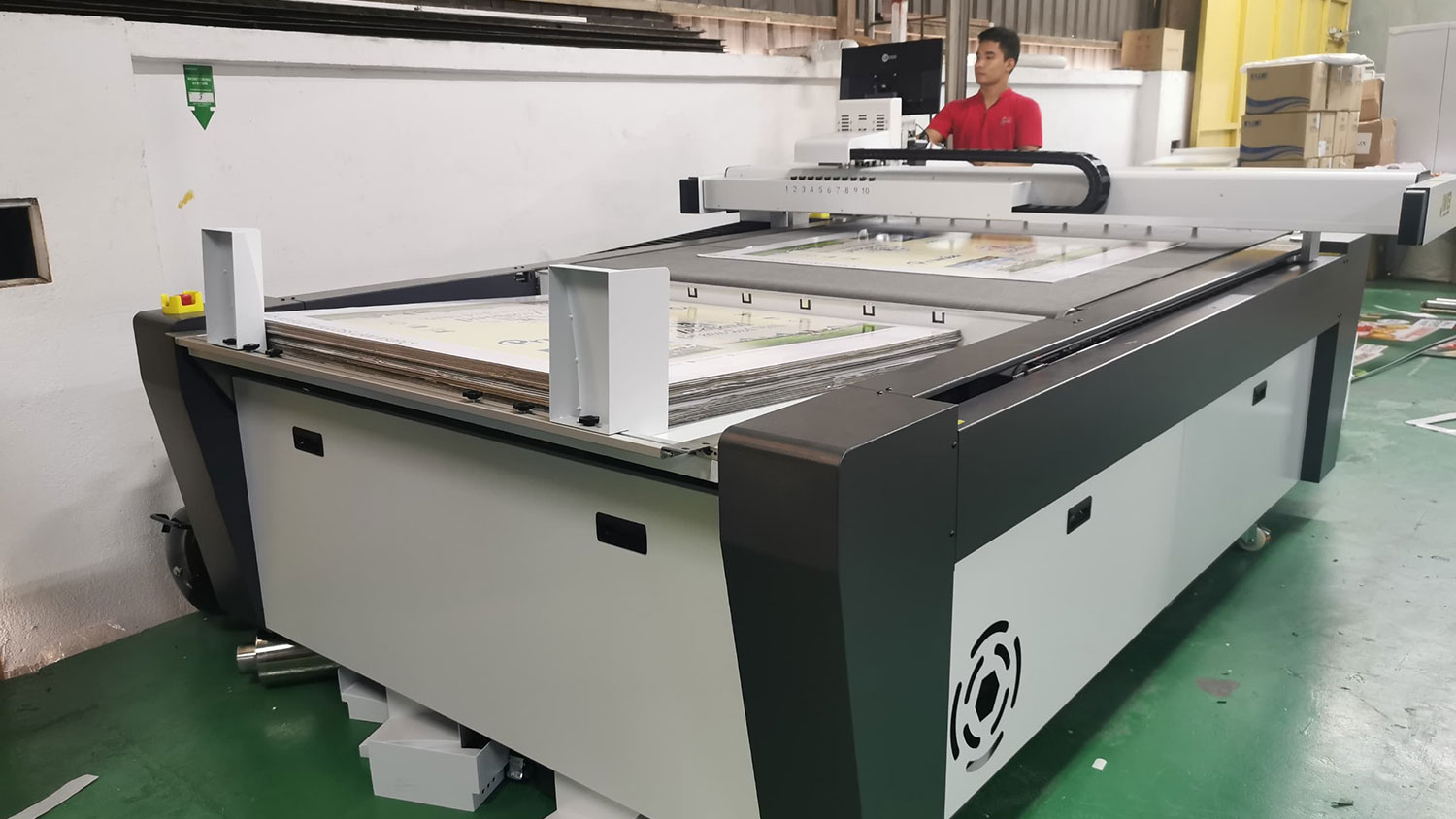
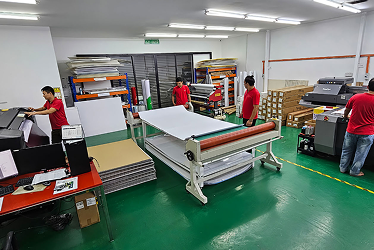
A cutting table set up for a run. Below a few hundred units you are paying for the setup more than the board, which is why small orders cost so much per piece.
The line items that hide
Three costs get left out of quotations more often than any others.
- RM __ per store in the Klang Valley, RM __ outstation, RM __ in East Malaysia. A quote without an installation line is not a cheaper quote. It is an incomplete one.
- A pallet to Penang and a pallet to Kota Kinabalu are not the same number. Sea freight to East Malaysia also adds days, which is a scheduling cost as much as a money one.
- Transit and installation damage is normal, not exceptional. Budget __%of the order. Replacing units one at a time afterwards costs several times the run rate.
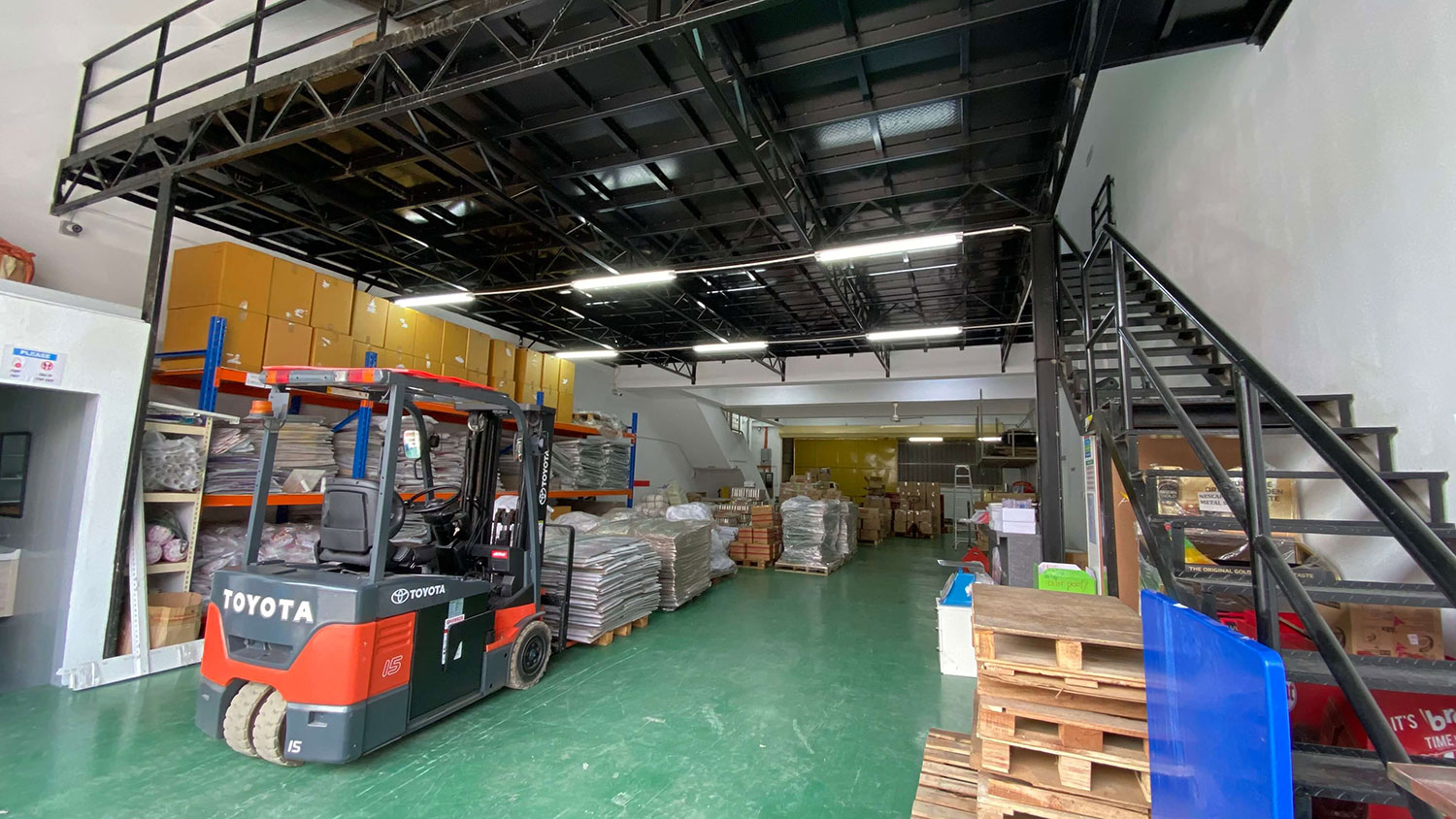
Palletised and staged. Warehousing, freight and replacement stock sit outside the unit price, and a quote that leaves them out only looks cheaper.
How a cheap quote gets cheap
A low number is rarely a discount. It is usually a narrower scope. The common routes:
- Board grade dropped after the sample is approved, so what ships isn’t what you signed off
- Structure never calculated, just copied from a shape that worked for a different product weight
- Installation excluded, then raised later as a variation
- No spares budgeted, so replacements are charged at one-off rates when units fail
- Artwork adaptation billed as design, with no structural development behind it
- Pre-production sample skipped to save cost and a week
Every one of these costs less at quotation and more at rollout.
Brief it properly and the quotes converge
Most of the spread between quotes comes from suppliers guessing at things the brief left out. Specify these and the numbers become comparable:
- Product weight per facing, and how many facings the unit must hold
- Lifespan in weeks, not “temporary” or “permanent”
- Store count and the actual store list, including East Malaysia
- Whether installation is in scope, and whether site surveys are needed
- Whether the unit has to be re-dressed for a later promotion
- The delivery window, and whether it lands in the CNY or Raya production peak
The number to budget against
Not cost per unit. Cost per store, landed and installed, across the life of the campaign.
Take the quote, add installation, add freight to the furthest stores on your list, add spares, then divide by the number of stores that will actually have a display standing at the end of week one. That figure is comparable between suppliers. An ex-factory unit price is not.
About INK Marketing
INK Marketing is a POSM supplier and retail display manufacturer in Seri Kembangan, Selangor, and one of the most awarded in Malaysia, with more than 30 industry honours since 2017 and a win in every year since 2021.
Founded in 2007 and led by managing director Datuk Kristy Liew, it runs the whole chain in-house: design, structural engineering, multi-material production, fulfilment and nationwide installation.
Judged and awarded by printers, marketers and clients alike:
- East Asia Top Leader Honors 2026 — Enterprise Award
- The Marketing Events Awards — Gold, Best Event on a Budget and Silver, Best Retail / Shopper Marketing (2025); Gold, Best Event and Silver, Best Event Production (2023); Silver, Best B2C Brand Experience (2021); Bronze, Best Retail / Shopper Marketing (2021, 2022)
- Marketing Excellence Awards — Bronze, Excellence in Retail / Shopper Marketing for Nestlé Malaysia’s Maggi Singing Pot (2025); Bronze, Excellence in Personalisation Marketing for Nestlé Purina PetCare (2024)
- MARKies Awards 2025 — Bronze, Most Effective Use of Omnichannel
- Golden Bull Award — Distinguished Bull Award, Malaysia (2025), up from Outstanding Bull Award (2024); Inspirational Entrepreneur Award to managing director Kristy Liew (2025)
- Malaysia Print Awards 2024 — 1st Prize, Advertising & Promotion (Tent Card / Wobbler / Standee); 1st and 2nd Prize, Digital Printing Advertising & Promotion
- Agency of the Year Malaysia — Silver, New Kid on the Block and Bronze, Event Marketing Agency of the Year (2023); finalist, Specialist Agency of the Year (2024)
- Black Dragon 2024 — Best Event or Experiential Marketing Campaign
- From clients — Nestlé Malaysia Most Innovative Design and Best 7-Eleven Standee Design, RTD (2019); Best Christmas Display in Modern Trade for Cadbury, Mondelez International (2017)
The work spans temporary displays — standees, block displays, entrance and gondola end dress-ups, flaglines, wobblers, shelf talkers, hangsells, roadshow displays, table tops, and permanent displays in wood, metal and high-pressure laminate, including power wings, pillar wraps, kiosks and outdoor signage. Production covers digital, offset, silkscreen and inkjet printing, spot UV, large-format lamination and die-cutting, gluing, heat bending, metal and wood fabrication, packing, collation and pallet storage.
INK Marketing is a member of the Supplier Ethical Data Exchange (SEDEX) and the Federation of Malaysian Manufacturers (FMM). Clients include multinational FMCG brands, retailers and marketing agencies across Malaysia.
www.inkmarketing.com.my | info@inkmarketing.com.my