Three quotes come back for the same floor display. RM480 a unit, RM540, RM610. Same brief, same 200 stores, same deadline.
The gap usually isn’t margin. It’s scope. The cheap one is quoting print and board. The expensive one has priced in a structural check, a pre-production sample, an installation crew, and spare units for the ones that get crushed in transit.
You pay for those things either way. The only question is whether you pay upfront or halfway through the rollout.
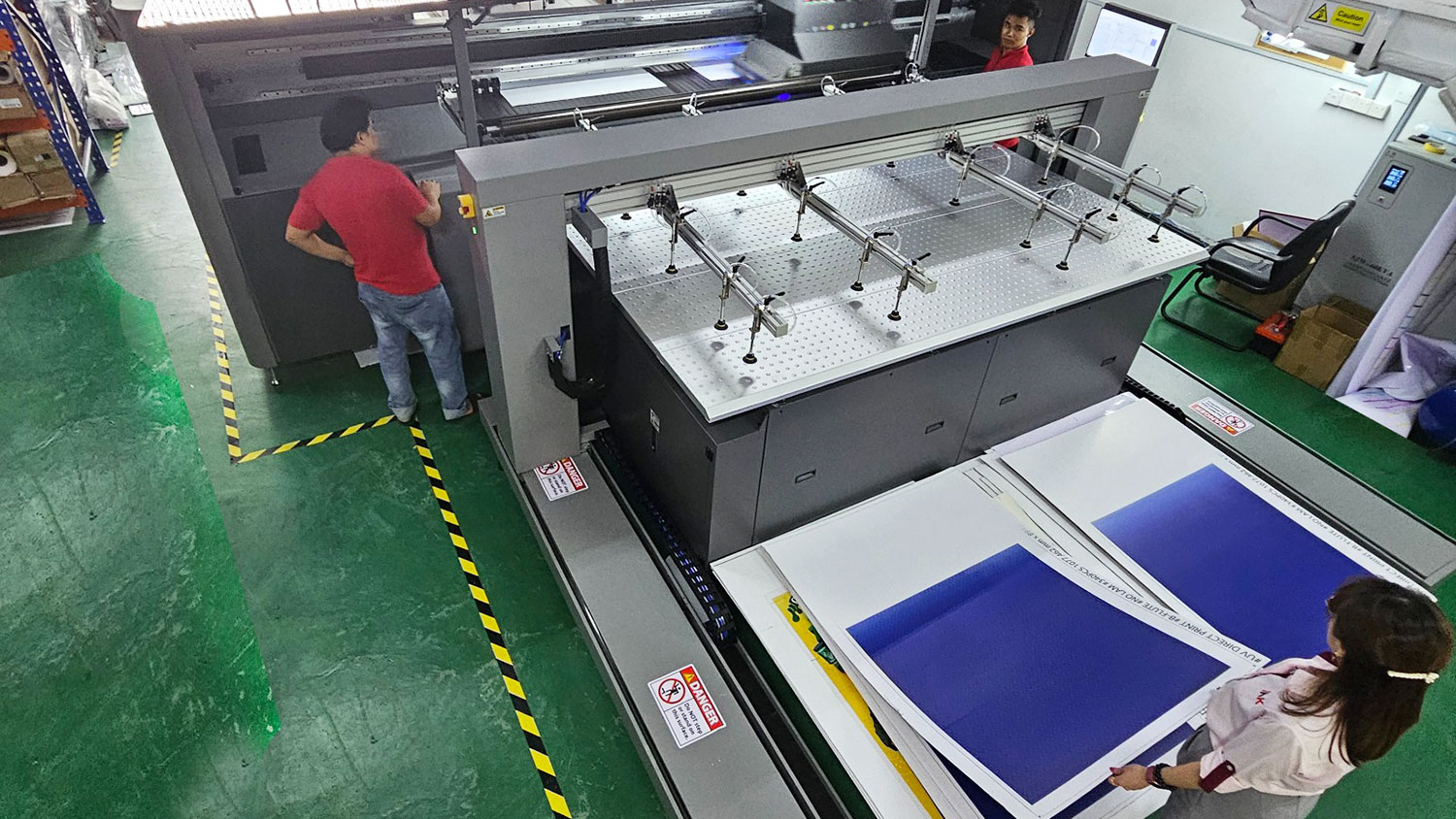
Most of the gap between three quotes sits in processes like this one, and in whether the supplier runs them or buys them in.
Seven things to check before you commit:
- Design — in-house designers, or freelancers hired per job?
- Structure — has anyone actually calculated what the display has to hold?
- Production — how much happens under their roof, how much gets farmed out?
- Installation — trained crews, or whoever drives the lorry?
- Rollout — can they tell you the status of one specific store?
- Project management — one person who knows your job, or a shared inbox?
- QA — is the standard agreed before production, or argued about after?
The rest of this is what each of those actually means.
Design capability
Adapting a KV isn’t designing a display. Adaptation is resizing artwork to fit a template someone else drew. Design starts with the shopper: what they see from three metres out, what they read from one metre, what their hand reaches for.
A supplier with real design people will push back on your brief. They’ll ask what’s sitting either side of you on that aisle, how many facings you need, whether the hero message still works when it’s seen at an angle by someone pushing a trolley past it.
If what comes back is your own KV pasted onto a standee shape, that’s adaptation. Nothing wrong with that, but don’t pay design rates for it.
Structural engineering
This is the one that quietly costs the most, because you don’t find out it’s missing until units start failing in store.
Renders don’t sag. Real displays do. A shelf rated by eye rather than by calculation will bow under a full load of 1.5-litre bottles. A tall unit on a shallow base tips forward the first time someone pulls from the top tier.
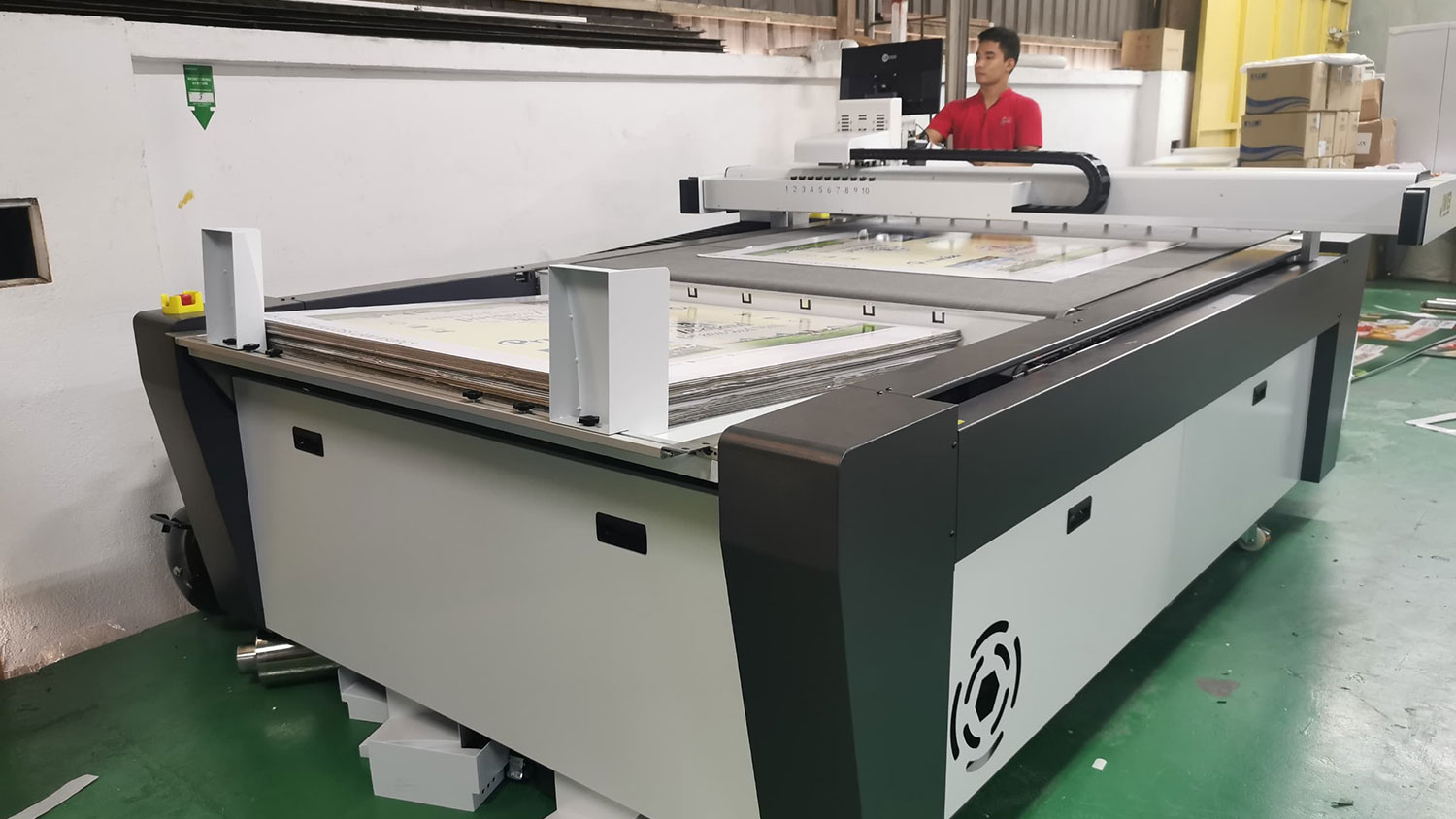
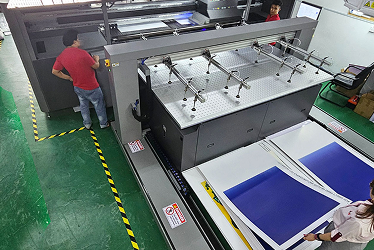
A flatbed cutting table working to a die-line. Parts cut here fold flat for transit, which is where most display damage happens.
Worth checking:
- Load — calculated against your actual product weight, not a guess
- Stability — base footprint against height, especially anything over 1.5m
- Materials — matched to lifespan. A three-week Raya promo and a two-year permanent fixture are not the same brief.
- Flat-pack — knock-down design cuts freight cost and damage, and most damage happens in transit
- Assembly — can store staff put it up without tools, and without reading anything
Production
Plenty of POSM suppliers in Malaysia are really trading companies. They win the brief, then send printing to one place, fabrication to another, finishing to a third.
That isn’t automatically bad. Some coordinators are excellent. But you should know, because it changes who is accountable when something is late.
It matters most on jobs that combine processes. One display might need offset printing, silkscreen, spot UV, large-format lamination, die-cutting, gluing and heat bending, plus metalwork if there’s a permanent element. Every handover is somewhere colour drifts and days disappear.
It matters even more in the run-up to CNY and Raya, when every brand in the country is producing at once and subcontractors start quietly reprioritising.
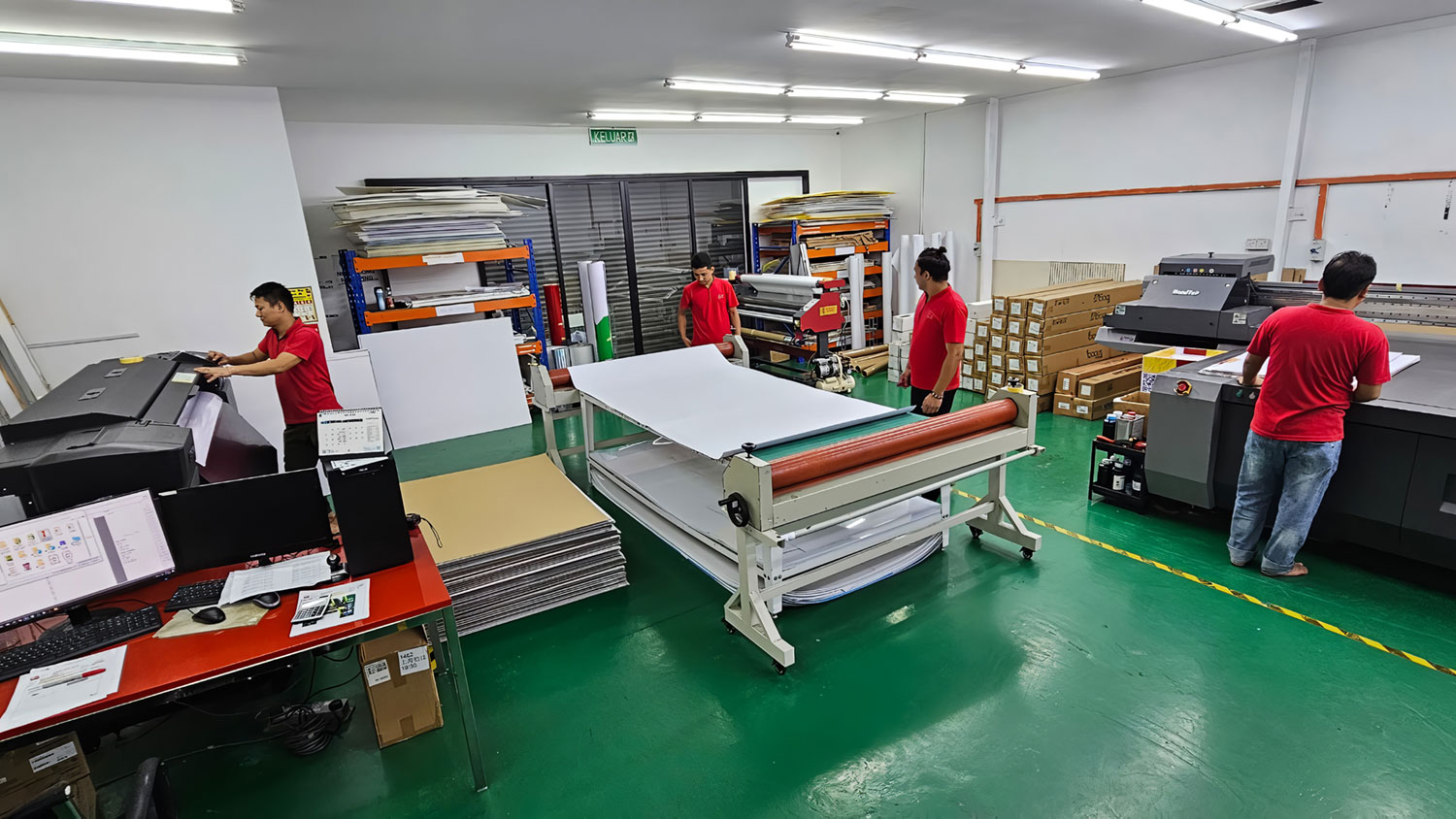
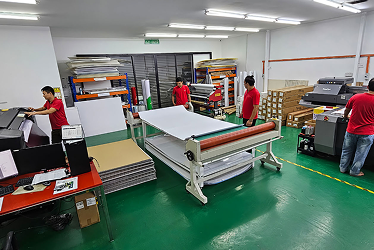
Printing, laminating and board finishing in one room. Every process that sits somewhere else is a handover where colour drifts and days disappear.
Installation
Good POSM installed badly performs like bad POSM.
Permanent fixtures especially. Uneven floors, walls you can’t drill, mall management approvals, centres that only allow work after closing. A crew that’s done it before sorted the access letter last week. A crew that hasn’t is standing outside at 10am with a display and no permission.
Insist on a photo of every installed site. It’s the only way you’ll know what actually went up.
Nationwide rollout
Malaysia looks small on a map and stops looking small the moment you’re shipping.
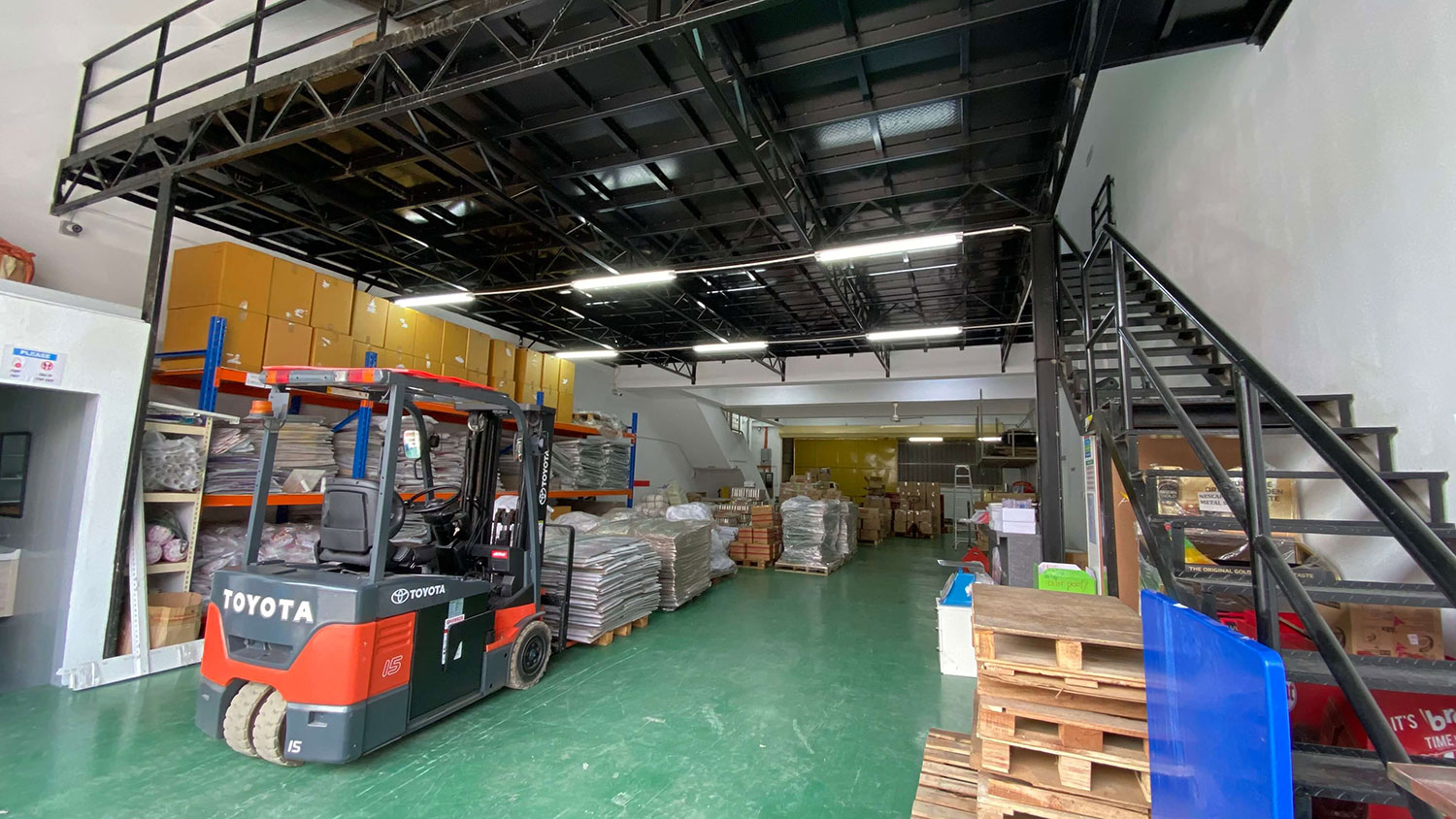
Palletised stock staged for release. Staggered delivery is what stops a store holding a campaign three weeks before it starts.
A rollout across Peninsular Malaysia, Sabah and Sarawak means sea freight schedules, different retailer approval processes, and store formats ranging from a hypermarket aisle to a shoplot where the display has to fit through the door first.
What separates suppliers here is unglamorous:
- Packing built for transit, not for looking neat in the warehouse
- Staggered delivery, so a store isn’t sitting on your material three weeks early
- East Malaysia lead times in the plan from day one, not added on later
- Spare units for transit damage, budgeted rather than begged for
- Store-by-store tracking
That last one is the tell.
Project management
Most POSM disasters are communication failures wearing a production costume.
Things go wrong on every campaign. What matters is whether you hear about it on day four or day eleven, because on day four you still have options.
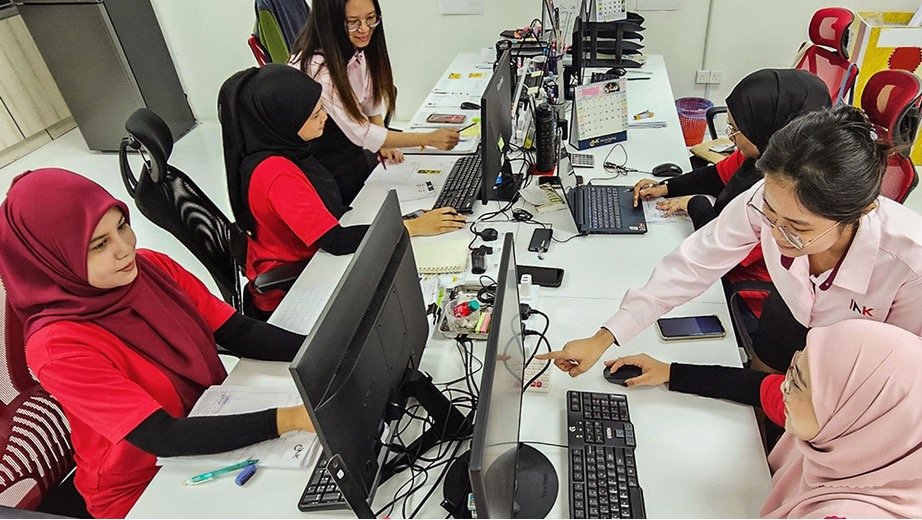
A servicing desk, not a shared inbox. Whether a problem reaches you on day four or on day eleven is decided here.
What good looks like: one person who knows your project by name, a schedule with real milestones for artwork, sample, production and delivery, and a phone call when something slips instead of an explanation afterwards.
A supplier who volunteers bad news early is rarer than it should be, and worth more than a lower quote.
Quality assurance
Agree the standard before production, not after.
- A pre-production sample you sign off
- A colour reference, and an agreed tolerance
- Checks during the run, not only at the end
- A stated process for rejects and replacements
If procurement needs it, ask about accreditation. SEDEX membership and FMM membership mean somebody outside the company has looked at how it operates.
The useful test
Stop comparing prices for a minute and compare scope instead.
Ask each supplier to write down what they’re responsible for, stage by stage, from artwork to installed display. Put the answers side by side. The gaps are the work that lands back on your desk.
That’s usually where the price difference went.
About INK Marketing
INK Marketing is a POSM supplier and retail display manufacturer in Seri Kembangan, Selangor, and one of the most awarded in Malaysia, with more than 30 industry honours since 2017 and a win in every year since 2021.
Founded in 2007 and led by managing director Datuk Kristy Liew, it runs the whole chain in-house: design, structural engineering, multi-material production, fulfilment and nationwide installation.
Judged and awarded by printers, marketers and clients alike:
- East Asia Top Leader Honors 2026 — Enterprise Award
- The Marketing Events Awards — Gold, Best Event on a Budget and Silver, Best Retail / Shopper Marketing (2025); Gold, Best Event and Silver, Best Event Production (2023); Silver, Best B2C Brand Experience (2021); Bronze, Best Retail / Shopper Marketing (2021, 2022)
- Marketing Excellence Awards — Bronze, Excellence in Retail / Shopper Marketing for Nestlé Malaysia’s Maggi Singing Pot (2025); Bronze, Excellence in Personalisation Marketing for Nestlé Purina PetCare (2024)
- MARKies Awards 2025 — Bronze, Most Effective Use of Omnichannel
- Golden Bull Award — Distinguished Bull Award, Malaysia (2025), up from Outstanding Bull Award (2024); Inspirational Entrepreneur Award to managing director Kristy Liew (2025)
- Malaysia Print Awards 2024 — 1st Prize, Advertising & Promotion (Tent Card / Wobbler / Standee); 1st and 2nd Prize, Digital Printing Advertising & Promotion
- Agency of the Year Malaysia — Silver, New Kid on the Block and Bronze, Event Marketing Agency of the Year (2023); finalist, Specialist Agency of the Year (2024)
- Black Dragon 2024 — Best Event or Experiential Marketing Campaign
- From clients — Nestlé Malaysia Most Innovative Design and Best 7-Eleven Standee Design, RTD (2019); Best Christmas Display in Modern Trade for Cadbury, Mondelez International (2017)
The work spans temporary displays — standees, block displays, entrance and gondola end dress-ups, flaglines, wobblers, shelf talkers, hangsells, roadshow displays, table tops, and permanent displays in wood, metal and high-pressure laminate, including power wings, pillar wraps, kiosks and outdoor signage. Production covers digital, offset, silkscreen and inkjet printing, spot UV, large-format lamination and die-cutting, gluing, heat bending, metal and wood fabrication, packing, collation and pallet storage.
INK Marketing is a member of the Supplier Ethical Data Exchange (SEDEX) and the Federation of Malaysian Manufacturers (FMM). Clients include multinational FMCG brands, retailers and marketing agencies across Malaysia.
www.inkmarketing.com.my | info@inkmarketing.com.my